
Why Roasters Love Ugandan Coffee Beans for Their Business

Updated: Dec 17, 2025
Why Traders and Bulk Buyers Prioritise Ugandan Coffee
Uganda is a critical origin in the global supply chain, offering a unique, dual-origin capability that strategically de-risks sourcing. Producing both robust, native Robusta and high-altitude, high-value Arabica, Uganda provides scale and versatility.
For traders and bulk buyers, securing consistent, high-quality supply from Uganda requires a forensic understanding of the in-country processing, logistical flow, and grading mechanisms.
This FAQ section dissects the journey of Ugandan green coffee beans from the initial buy station to your destination port, focusing on the metrics that drive commercial success and satisfied roaster clients.
Processing, Standardisation, and Risk Control
Uganda’s processing standards are the foundation for quality assurance and contract fulfilment. Understanding the two main stages is vital for guaranteeing the consistency your roasters demand.
Primary Processing: From Cherry to Fair Average Quality (FAQ)
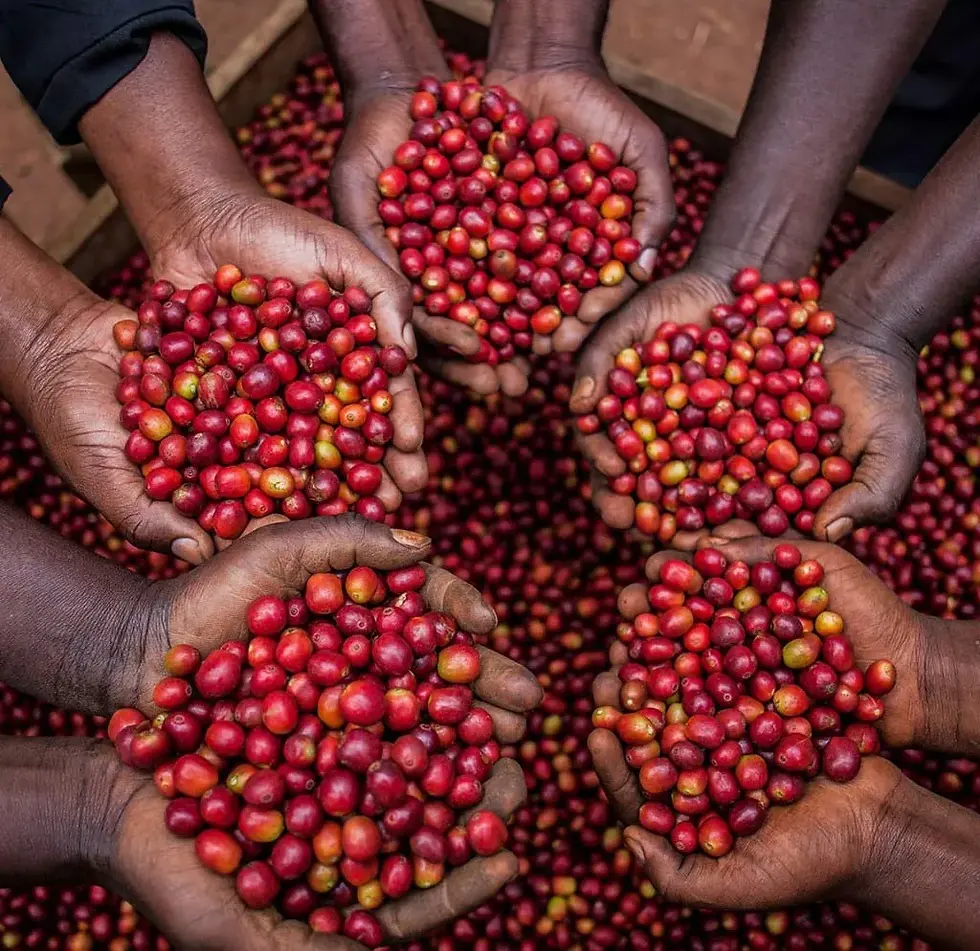
This initial stage handles the raw conversion of the coffee fruit into a transportable, intermediate product.
Harvesting: Ripe cherries are handpicked and sun-dried on surfaces for 5–7 days.
Hulling/Milling: The resulting dry coffee cherries (Kiboko) are milled in a primary facility to remove the husk.
Result: Fair Average Quality (FAQ)
This yields the Fair Average Quality (FAQ) green bean, a necessary intermediate step before final grading.
What FAQ Means for the Trade: Fair Average Quality (FAQ) is a standardised commercial benchmark representing the average quality of the current harvest volume. It is used as a foundational trading unit for large, unsorted bulk lots. While it is suitable for general commercial trade, the FAQ lot maintains a wider tolerance for defects and inconsistencies in bean size.
For the discerning buyer, FAQ is an input commodity that must be refined through secondary processing to meet strict export-grade contracts and ensure the even roasting characteristics your customers require.
Secondary Processing: Refining Volume into Export Quality
The FAQ stock is transformed into homogenous, export-ready grades through a technical, multi-stage machine process. This stage is crucial for value addition and consistency.
Machine Process | Function / Benefit to Trader (Consistent Quality & Reduced Risk) |
Foreign Matter (FM) Sorting | Removes non-coffee materials (sticks, leaves), ensuring product purity and reducing damage risk. |
De-stoner | Removes stony particles that could damage roasters, mitigating risk for your end customer. |
Density Sorter | Crucial for Quality Yield. Separates less dense, chalk-white (immature) beans from the desired, finely dense beans, improving cup quality potential. |
Colour Sorter | Removes black-coloured beans (defects), raising the visual grade and defect score. |
Screen Grading | Separates the clean beans by physical size (Screen 18, 15, 12), ensuring batch uniformity for even roasting. |
The Definitive Uganda Coffee Export Grades
Uganda standardises its exports into distinct grades based on bean size and processing, allowing buyers to reliably source for specific application needs, from high-volume commercial blends to high-value specialty offerings.
Uganda Robusta Coffee Grades (Screen Size Based)
Robusta, Uganda’s indigenous and dominant commodity, is graded by screen size, reflecting bean uniformity essential for high-volume espresso and commercial blends.
Grade Name | Screen Size (Uniformity Focus) | Characteristics & Commercial Application |
Screen 18 | Biggest bean size | Premium Robusta. Highest uniformity for controlled, even roasting. Ideal for high-end espresso blending. |
Screen 15 | Medium bean size | Standard Commercial Grade. The dependable backbone of commodity Robusta supply. |
Screen 12 | Small bean size | Lower end of the commercial spectrum. Suitable for extracts or lowest-cost blending. |
Undergrades | BHP, Chalk white, Black Beans | Exported separately. Used for industrial extracts or extremely low-grade blending. |
Ugandan Arabica Coffee Beans (Processing & Region Based)
Sourced primarily from high-altitude regions like Mt. Elgon (Bugisu) and Rwenzori, Ugandan Arabica addresses the specialty market demand.
Category | Process | Grades Available | Key Profile Notes (High-Value Market Focus) |
Washed Ugandan Arabica (WUGAR) | Wet Processed (pulped, washed, then dried). Specialty process. | Bugisu AA (largest), Bugisu AB (medium), Bugisu PB (peaberry) | Highest Quality/Clean Cup. Offers rich acidity and aromatic profiles. Excellent high-score single-origin specialty. |
Dried Ugandan Arabica (DRUGAR) | Natural/Dry Processed (sun-dried with fruit intact). | Generally not screen-graded but well-sorted and packed. | Classic Natural Profile. Full-bodied with winey/fruity notes. A cost-effective component for natural espresso blends. |
Importer FAQs: Logistics, Quality, and Sourcing Ugandan Coffee Beans
Volume and Market Position
1. What rank is Uganda in coffee production? Who is the largest coffee producer in Africa?
Uganda is a global volume player, consistently ranking in the top 10 globally (currently around 7th or 8th). Crucially, Uganda is the largest coffee producer in Africa by volume. This high and reliable output ensures significant commercial availability and makes Ugandan green coffee beans a secure choice for large-volume importers seeking supply chain stability.
2. Does Uganda have good coffee? How does the quality benchmark internationally?
Yes. Uganda is recognized for both scale and quality. While its volume is driven by Robusta, its specialty Arabica (Bugisu) competes directly with East Africa’s best. Uganda has been ranked as high as 3rd best in the world for overall coffee quality by certified tasters (Coffee Quality Institute). This dual offering allows bulk buyers to cover both commodity and specialty segments from a single origin.
3. How do I identify high-quality beans for my roaster clients?
Ensure the beans meet these criteria:
Grade: Verify the official grade (e.g., Washed Arabica Bugisu AA, Robusta Screen 18).
Defect Count: High-quality beans must adhere to minimal defect tolerances (e.g., Specialty Grade requires a score of 80+ and max 5 defects per 300g sample).
Physical Appearance: Beans must be uniform in size and density to guarantee an even roast—a key requirement for roasters. Always request a Certificate of Origin and Quality from your exporter.
Logistical Efficiency and Cost Structure
4. How is Ugandan coffee quoted, and what are the payment terms?
Pricing Basis: Prices are typically quoted FCA/FOT (Free on Truck) or Ex-Factory, meaning the buyer assumes responsibility for transport costs and risk from the point the coffee leaves the facility or is loaded onto the truck. This clear delineation helps you manage your final landed cost.
Payment: Standard commercial practice requires an initial deposit (e.g., 50%) upon price confirmation, with the balance paid upon presentation of export document copies (Proof of Shipment/Bill of Lading).
5. What are the Logistics involved to import Ugandan coffee beans?
As a landlocked origin, the primary logistics corridor for Ugandan green coffee beans is via overland truck transport to the major East African ports of Mombasa, Kenya, or Dar-es-Salaam, Tanzania, where they are loaded onto ocean freight vessels. Buyers must factor in the inland haulage cost and transit time, although specialised shipping lines offer integrated services managing the entire chain from Kampala through the port.
6. What is the minimum order for importing Ugandan coffee?
To achieve optimal logistical efficiency and unit cost, the most economical shipment for bulk buyers is a full 20-foot container (approximately 19,800 Kgs / 330 bags). Orders significantly smaller than this will incur disproportionately high freight and handling costs.
7. What documentation is required to ensure smooth importation and compliance?
To legally import, the shipper will provide standard export documentation, which typically includes:
Commercial Invoice and Packing List
Bill of Lading (B/L) or Air Waybill
Certificate of Origin (proving the coffee is from Uganda)
Phytosanitary Certificate (ensuring the beans are pest-free)
Coffee Quality Certificate (issued by the Uganda Coffee Development Authority or a licensed grader)
Compliance Note: For markets like the European Union, additional documentation such as a Due Diligence Statement (DDS) may be necessary for compliance with regulations like the EU Deforestation Regulation (EUDR).
Uganda Coffee Quality Percentage & Pricing
8. Uganda coffee quality percentage & Grading Score
Specialty Grade Percentage: Approximately 29% to 32% of all Ugandan green coffee beans are classified as specialty, primarily high-altitude Arabica (Bugisu) and fine Robusta.
Specialty Quality Threshold: To qualify as Specialty Grade, a green coffee bean sample must achieve an SCA Cupping score of 80 points or higher and have a maximum of 5 defects per 300g sample.
9. How much is 1kg of green coffee in Uganda? (Wholesale Pricing Basis)
As a bulk importer, your focus is on the wholesale price of green coffee beans (FOB or Ex-Factory).
Note: Coffee pricing is highly volatile, fluctuating daily based on the ICE futures market (NYSE:KC for Arabica, NYSE:RC for Robusta) and local differentials. The figures below are recent wholesale price ranges for green beans in Uganda and should be used as a guideline, not a firm quote.
Coffee Type & Grade | Price Basis (Per Kilogram) | Approximate USD Wholesale Range (Green Beans) |
Robusta (Screen 15/12 - FAQ) | Ex-Factory/FOT/FOB Mombasa - (Bulk Commercial) | $2.50 - $5.00 per kg |
Arabica (WUGAR - Bugisu AA) | Ex-Factory/FOT/FOB Mombasa (Specialty Grade) | $4.50 - $8.50 per kg |
Disclaimer: This pricing reflects the wholesale cost for green Ugandan coffee beans ready for export and does not include the cost of international freight, insurance, or import duties, which determine the final Landed Cost.
Take the Next Step: Source Your Ugandan Coffee Beans from a reputable Ugandan Coffee Exporter.
The unique combination of high-quality specialty Arabica and globally competitive Robusta makes Uganda an essential origin for any diversified roaster. Its high quality score and clear grading system ensure you receive reliable, traceable, and flavourful Ugandan coffee beans.
Ready to secure your next container of premium Ugandan coffee beans?
Contact a certified Ugandan exporter today to request a current price list, pre-shipment samples of our screened grades and ensure your customer's next roast meets the international standard of excellence.


Comments